
Why Did Peak Traffic Become the Worst Enemy?
Every developer knows the sinking feeling of watching their system buckle under unexpected load. Our API services were experiencing frequent outages during peak traffic, cascading failures that would bring down entire service chains, and frustrated users abandoning our platform. With peak loads reaching 40 requests per second, our traditional monolithic approach was failing spectacularly.
The wake-up call came during a particularly bad incident where a single service failure brought down our entire platform for 6 hours. We knew we had to rethink our architecture fundamentally.
Warning
One slow downstream service was enough: requests piled up, timeouts cascaded upstream, and six hours later we were still recovering. The failure of a single component must never take the whole platform with it.
What Does the Queue-Driven Architecture Look Like?
After analyzing our failure patterns, we designed a resilient API gateway system built around three core principles:
- Asynchronous processing to handle traffic spikes
- Intelligent caching to reduce downstream pressure
- Graceful degradation to prevent cascading failures
Architecture Overview
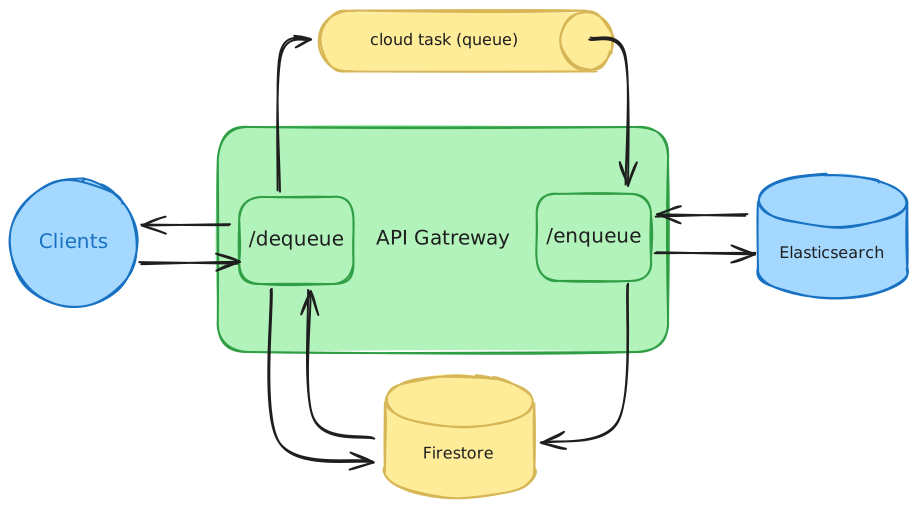
Our solution centers around an API gateway that acts as a traffic coordinator rather than a simple proxy. Here’s how the components work together:
Component Breakdown
API Gateway: The central orchestrator that receives all client requests and makes intelligent routing decisions based on system health and load patterns.
Queue System (/enqueue & /dequeue): Instead of processing requests synchronously, we enqueue them for asynchronous processing. This creates a natural buffer that absorbs traffic spikes without overwhelming downstream services.
Cloud Tasks Queue: Provides reliable, scalable task processing with automatic retry mechanisms and dead letter queues for failed tasks.
Firestore Cache: Stores Elasticsearch query results for 24 hours, dramatically reducing the load on Elasticsearch by serving frequently accessed data from cache.
Elasticsearch: Our search and analytics engine, protected by rate limiting to ensure it never receives more than 10 req/s, maintaining stability even during traffic spikes.
Which Design Decisions Made the Difference?
1. Embracing Asynchronous Processing
The biggest architectural shift was moving from synchronous request-response to asynchronous processing. When a client makes a request:
- The API gateway immediately returns an acknowledgment with a task ID
- The actual processing happens asynchronously in the background
- Clients can poll for results or receive webhooks when processing completes
This approach eliminated the direct coupling between client requests and backend processing time, making our system inherently more resilient to load spikes.
sequenceDiagram
    client->>gateway: POST /enqueue
    gateway-->>client: 202 Accepted (task ID)
    gateway->>queue: enqueue task
    queue->>worker: deliver (rate limited)
    worker->>cache: check Firestore
    cache-->>worker: miss
    worker->>es: query (<= 10 req/s)
    es-->>worker: results
    worker->>cache: store (24h TTL)
    client->>gateway: GET /dequeue (task ID)
    gateway-->>client: results
2. Smart Caching with Firestore
We implemented a simple but effective caching strategy using Firestore to cache Elasticsearch results for 24 hours. This dramatically reduces the workload on Elasticsearch by serving frequently requested data from cache rather than executing expensive search queries repeatedly.
The cache hit rate improvement alone reduced our Elasticsearch load by approximately 30-40% during peak hours.
3. Rate Limiting to Prevent Cascading Failures
The key insight was that cascading failures occurred when traffic spikes overwhelmed Elasticsearch, causing it to fail and affecting all clients. Our solution was elegant: implement rate limiting at the queue level to cap requests to Elasticsearch at 10 req/s.
This approach provides several benefits:
- Elasticsearch stability: By never exceeding 10 req/s, Elasticsearch remains healthy and responsive
- Isolated failures: All client requests are queued, ensuring Elasticsearch never gets overwhelmed. In the original approach, traffic surges would cause Elasticsearch to fail completely, bringing down all clients. Now, all clients continue to work (albeit potentially slower due to queuing) rather than experiencing complete failure
- System-wide protection: No single client can bring down the shared Elasticsearch instance
What Were the Results?
The impact was immediate and measurable:
Note
Downtime dropped by 70% (from 6 hours to roughly 2 hours of recovery for affected clients), and the platform stayed up through every peak-traffic event since.
- 70% reduction in downtime through graceful degradation and fault isolation (reduced from 6 hours to 2 hours recovery time for affected clients)
- Consistent performance even during peak loads of 40+ req/s
- Zero cascading failures through intelligent rate limiting that protects Elasticsearch
- Graceful degradation: all clients continue working (potentially slower) instead of complete failure
- Improved user experience with faster response times due to intelligent caching
What Would We Do Differently?
The Good
- Queue-based processing was a game-changer for handling unpredictable traffic
- Rate limiting at the queue level provided excellent protection against cascading failures
- Simple but effective caching with 24-hour TTL dramatically reduced Elasticsearch load
The Challenges
- Complexity: Managing asynchronous workflows requires careful error handling and monitoring
- Debugging: Tracing requests through multiple services became more complex
- Consistency: Ensuring data consistency across cache layers required thoughtful design
Building for the Real World
Creating resilient systems isn’t about perfect code: it’s about understanding that failure is inevitable and designing accordingly. Our API gateway system proves that with thoughtful architecture, you can build systems that not only survive peak loads but actually perform better under pressure.
The 70% downtime reduction wasn’t just a number; it translated to happier users, fewer 3 AM emergency calls, and a development team that could focus on features instead of firefighting.
Remember: the best system design is one that gracefully handles the unexpected. Plan for failure, embrace asynchronous patterns, and always have a fallback plan.