
Managing configurations across multiple environments and services is one of those things that should be simple, but rarely is.
If you’ve worked with .env files, you know the drill: every environment (e.g., sit, uat, canary, prod) has its own set of config files, and every service (be it Cloud Run, Dataflow, or others) duplicates a large portion of the same values. Add CI/CD pipelines into the mix, and the friction becomes obvious. Slight changes in config require regenerating .env files, updating deployment scripts, and often maintaining separate CI/CD logic per service and per environment.
This setup creates redundancy and slows down delivery.
So I built an OOP-based configuration framework in Python, built on top of Pydantic, to simplify and centralize configuration management. Here’s how it works.
Why do configs get so redundant?
In most systems, we deal with multiple environments, such as sit (system integration test), uat (user acceptance test), canary, and prod (production).
Some teams might use different naming conventions like dev, qa, stage, or preprod, but the core challenge remains the same: Each environment requires its own config setup, often with small differences.
Additionally:
- Each service (e.g., Dataflow job, Cloud Run service) needs its own config.
- A large portion of the config values are shared (Docker registry URLs, GCP credentials, etc).
- CI/CD pipelines often need to be duplicated to reflect these separate configurations.
That’s a lot of repetitive work for something that’s logically hierarchical and composable.
Note
The tell-tale smell: a config change that touches three environments means three
.envedits, three deployment-script checks, and three chances to get it wrong. Hierarchy collapses all of that into one edit at the right layer.
What does a layered config look like?
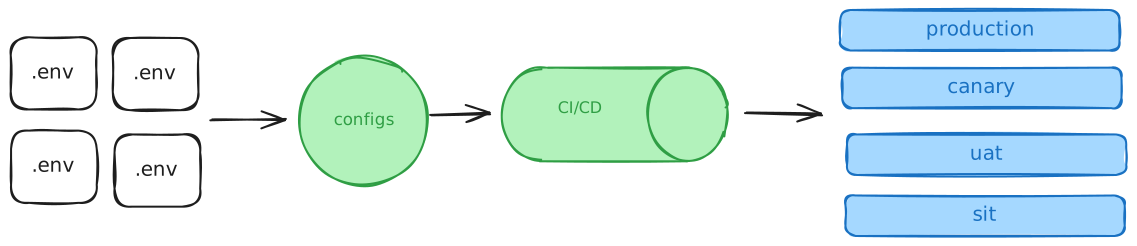
Instead of treating configs as raw key-value pairs in .env, I defined them as Python classes, layered to reflect how configs are structured in reality.
The framework is built on Pydantic’s BaseModel for type-safe config validation, and Object-Oriented Programming (OOP) to encourage composition and reuse.
Let’s walk through the layers.
Base Layer: BaseConfigs
Contains shared, global settings like:
env: environment identifier (e.g.,sit,prod)is_localhost: true/false for local developmentlogging_level_per_module- Local GCP credentials path
Also provides template methods such as:
setup_environment()deploy()assert_deploy()
Each environment-specific mixin (e.g., ProdConfigsMixin) will override env = "prod" and anything else environment-specific.
Service Layer: e.g. DataflowConfigsMixin, CloudRunConfigsMixin
Contains service-specific variables:
For example, in DataflowConfigsMixin:
dataflow_job_namedataflow_gcp_projectdataflow_subnetwork
Also contains service-specific behavior like:
deploy()method for triggering Dataflow jobassert_deploy()logic tailored to Dataflow logs or job status
For a Cloud Run-based service, you’d swap in CloudRunConfigsMixin.
Instance Layer: e.g. DataflowJobAConfigsMixin
Overrides any instance-specific config:
dataflow_job_name = "dataflow_job_a"assert_deploy()might validate output in BigQuery or check an API result
Each job or service instance gets its own mixin, where you specialize the behavior.
How do the pieces come together?
Here’s how all the pieces assemble in configs.py:
sit_configs = SitCommonConfigs()
uat_configs = UatCommonConfigs()
canary_configs = CanaryCommonConfigs()
prod_configs = ProdCommonConfigs()

configs = get_configs(
    prod_configs=prod_configs,
    canary_configs=canary_configs,
    uat_configs=uat_configs,
    sit_configs=sit_configs,
)
get_configs() returns the config object for the current environment, determined by a single ENV variable in .env.
Example of an environment-specific class:
class ProdCommonConfigs(
    DataflowJobAConfigsMixin,
    ProdDataflowConfigsMixin,
    DataflowConfigsMixin,
    ProdConfigsMixin,
    BaseConfigs,
):
    pass
What does the CLI give us?
We provide a small CLI tool (ac, short for Abacus Configs) with a few essential commands:
ac echo_configs
Outputs all resolved configs for the current environment:
> ac echo_configs
export ENV=sit
export IS_LOCALHOST=True
export DATAFLOW_GCP_PROJECT=production-project
...
You can use this in shell sessions or pipelines with:
> eval $(ac echo_configs)This means you can dynamically generate environment variables from your Python config at runtime: no more handcrafting .env files for CI/CD.
Tip
eval $(ac echo_configs)inside a pipeline step means the pipeline itself carries zero environment-specific values. The same YAML deployssit,uat, andprod: only theENVvariable changes.
ac deploy
Triggers the appropriate deploy() method for the current config. Could be deploying a Dataflow job or pushing to Cloud Run, depending on the config object’s class structure.
ac assert_deploy
Runs validations defined in the config class:
- Check for logs
- Confirm data landed in a target system
- Make an API call to confirm behavior
This fine-grained control is often needed to test service correctness post-deployment.
Why does this work?
Because all config objects implement the same interface (deploy, assert_deploy, etc.), CI/CD pipelines no longer need to be duplicated per service or environment.
Here’s what changes:
- Environment-specific behavior is encoded in the config object
- CI/CD pipelines can simply run
ac deployandac assert_deployin the right environment - Adding a new service or environment requires only a new config class, not a whole new pipeline
On top of that:
- Zero duplication: shared logic and values are defined once, and reused through inheritance
- Type-safe: configs are validated early using Pydantic
- Flexible overrides: environment, service, and instance layers allow for precise customizations
- Testable & extensible: logic like
deploy()can easily be unit tested or extended - Unified CI/CD: one pipeline logic to rule them all
Where to take it next
This configuration system has significantly reduced overhead for our dev teams. It’s made configs declarative, validated, and reusable, and has unified deployment across environments and services.
If you’re finding yourself copying .env files, duplicating CI pipelines, or fighting config drift, this might be worth exploring in your Python projects.