Crude oil isn’t just another commodity: it’s the heartbeat of the global economy. From powering vehicles and planes to influencing inflation and monetary policy, crude oil prices ripple across every corner of modern life.
But predicting those prices? That’s notoriously hard.
Volatile by nature and influenced by everything from geopolitics to pandemics, oil prices can shift in ways that baffle traditional models. That’s why our research set out to answer a critical question: Can deep learning models do better?
Turns out, they can, and they do.
Why Traditional Models Fall Short
For decades, researchers have turned to models like ARIMA, GARCH, and SVM to forecast oil prices. While these models have their strengths, they struggle with capturing the chaotic and nonlinear nature of crude oil markets.
Enter deep learning, and more specifically, two powerful tools in the neural network toolkit: Convolutional Neural Networks (CNN) and Long Short-Term Memory (LSTM) networks.
What Makes CNNs and LSTMs a Good Fit?
- CNNs are great at identifying spatial patterns, like spotting trends in technical indicator data over time.
- LSTMs excel at remembering sequences, perfect for time series like daily oil prices.
Our hypothesis? Combine them effectively, and you get the best of both worlds: CNNs to detect patterns, and LSTMs to understand their evolution over time.
Our Approach: CNN-LSTM vs. LSTM-CNN
We designed and compared two hybrid models:
- CNN-LSTM: First, use CNN layers to extract features, then feed those into LSTM layers for sequence learning.
- LSTM-CNN: Reverse the order: start with LSTM for temporal dependencies, then use CNN for pattern detection.
For benchmarking, we also tested standalone CNN and LSTM models, along with classic strategies like Buy & Hold, RSI, MACD, and Stochastics.
Data and Features
We used WTI crude oil data from 2005 to 2020 pulled from Yahoo Finance. The dataset included technical indicators like:
- Trend: SMA, MACD, ADX
- Momentum: RSI, ROC, Stochastic RSI
- Volatility: Bollinger Bands, ATR
- Volume: OBV, ADI, CMF
We carefully preprocessed the data: normalizing values, applying transformations for stationarity, and labeling using smoothed price returns.
How Did the Models Perform?
We measured performance using two metrics:
- Prediction Error (MSE)
- Trading Performance (ROI and Sharpe Ratio)
Prediction Accuracy
Both hybrid models outperformed the standalone CNN and LSTM in prediction accuracy. LSTM-CNN and CNN-LSTM achieved significantly lower MSE scores, showing better predictive capability, especially important during volatile years like 2020.
Trading Performance
This is where things got exciting:
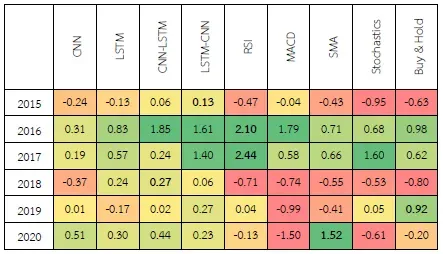
- LSTM-CNN achieved an average annual ROI of 17.8%, the highest among all strategies.
- CNN-LSTM was close behind with 16.6%.
- In contrast, Buy & Hold and traditional technical indicators struggled, especially during turbulent periods.
When looking at risk-adjusted returns, LSTM-CNN also had the highest Sharpe ratio (0.62), outperforming CNN-LSTM (0.48) and RSI (0.55).
Key Insights
- Hybrid deep learning models clearly outperform traditional approaches in both prediction and trading effectiveness.
- Model architecture matters: the order of layers (LSTM before CNN or vice versa) can significantly impact real-world results.
- Even slight improvements in predictive accuracy can translate to substantial gains in trading performance.
Final Thoughts
Crude oil markets are complex, but our research shows that smart combinations of deep learning architectures can decode that complexity better than older models or simplistic technical indicators.
If you’re in finance, data science, or energy analytics, now’s the time to start paying serious attention to what hybrid AI models can do.
“While volatility in oil markets is here to stay, our tools for navigating it are finally catching up.”
Read the Full Research Paper
This blog post summarizes our findings. To explore the full research paper with detailed methodology, experiments, and references, visit the official publication:
Read the full paper at the Journal of Advances in Information Technology (JAIT)